
Controlled AI video production is really a question of organisation. The difference between a one-off visual experiment and a reliable output is not a better prompt; it is a clear structure that decides what is fixed, what is experimental, and how references relate to each other before anything is generated.
That structure is unglamorous, and it is exactly what most people skip when they start generating video. This article lays out the organisational habits that turn a promising but unpredictable tool into a production method you can depend on, one where a good result is the outcome of a process rather than a lucky roll.
Because it supports reference control and editing, Seedance 2.5 fits teams that want more than a single lucky render.
Contents
Organise the idea before generation
Start by writing the central idea, listing the required visual beats, and collecting references under clear labels. Decide which details are locked and which are open to testing before you open the generator.
This organisation is what makes generation controllable: the model produces the sequence, but the structure you built determines whether the result is usable. Skipping this step is how teams end up with a folder of clips and no way to say which one is right, because there was never a standard to judge them against in the first place.
Build a reference hierarchy
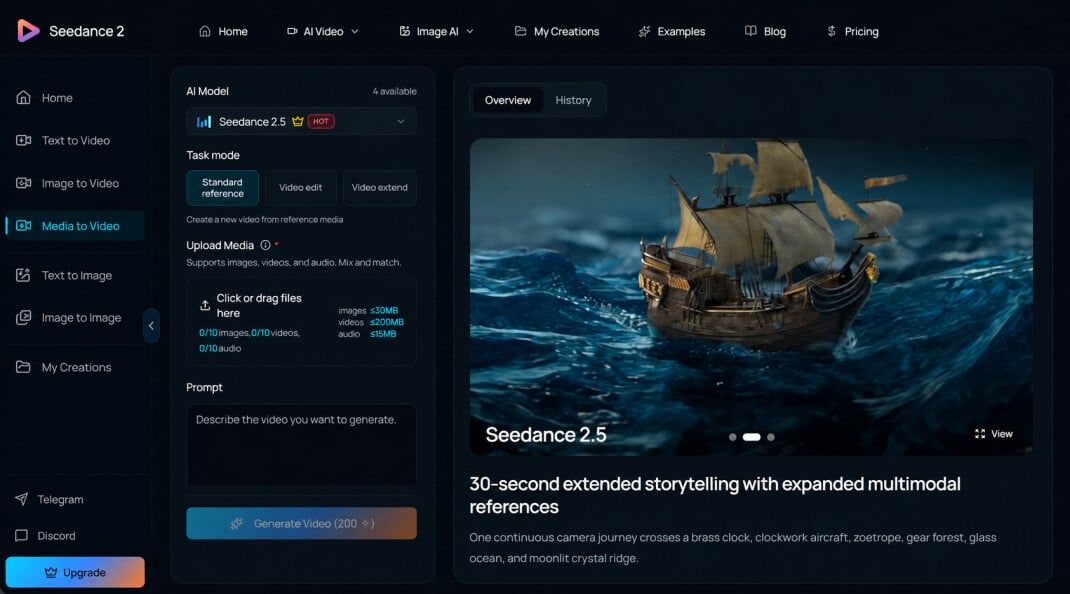
Not every reference deserves equal authority. Identify the primary character or product reference, the environment reference, the movement reference, and any style guidance, and rank them so conflicts have a clear resolution. This hierarchy is exactly what a multimodal model like Seedance 2.5 depends on, since it generates against the reference set you rank and approve, and conflicting inputs produce inconsistent scenes.
Image: Seedance 2.5 Media-to-Video interface for multimodal reference inputs — courtesy of the official website (https://seedance2video.io/seedance-2-5).
If two references conflict, resolve that conflict before generation rather than discovering it in the output. Store the final set as an approved package for the scene, which prevents the common problem of changing inputs between iterations and then wondering why continuity changed too. A ranked, settled reference set is the difference between controlled iteration and guessing.
Describe sequences in beats
A visual sequence is easier to control when the prompt follows the order of events. State the opening composition, the action, the camera movement, the transition, and the final frame, and if several characters are involved, explain their roles and relative positions. Described this way, a beat list also plays to Seedance 2.5’s scene and camera control, because each stated action and movement becomes something the model can execute rather than guess.
Keep the language concrete. A person walks from the left of the frame toward the doorway is a production instruction; make the scene dynamic gives the model and your colleagues about the same amount of information, which is to say almost none. Beats give you named parts you can revise individually, instead of a single blur you can only regenerate as a whole.
Version systematically
Save successful generations with a meaningful version name and record what changed between them. If a revision improves the camera but damages character continuity, return to the previous version instead of rebuilding from memory.
This simple habit is essential once a project accumulates experiments, because memory is unreliable and good versions are easy to lose. Controlled production does not mean eliminating experimentation; it means making experimentation reversible and understandable, so progress is never accidentally traded away for a change that looked better in the moment.
Assign clear ownership
When more than one person works on a sequence, ambiguity about who owns which decision is a bigger risk than any single wrong render. Decide who controls the references, who writes the prompts, who reviews continuity, and who gives final approval.
Clear ownership keeps a controlled process from dissolving the moment it involves a team. It also makes review faster, because each reviewer knows exactly what they are responsible for, and it prevents the situation where everyone assumed someone else had checked the detail that turned out to be wrong.
Review and confirm rights
Check each version against the brief, note any on-screen text that needs correcting, and confirm you were entitled to use every reference in the approved package.
A short record of sources keeps accountability clear when several people contribute to the same sequence, and it makes a later question about where an asset came from a quick lookup rather than an investigation. Rights, like continuity, are far easier to manage as part of the structure than to reconstruct after the fact.
Separate the reusable from the one-off
In controlled production, some assets are worth keeping, and some are genuinely single-use. Identify which references, character definitions, and settings will recur across projects, and store those with extra care, while treating truly one-off experiments as disposable so they do not clutter the system.
This distinction keeps the archive useful. A reference library that mixes durable, reusable assets with every throwaway test becomes as hard to navigate as no library at all.
Deciding, as you work, what deserves to be kept and what can be discarded is part of the organisational discipline that makes controlled production sustainable over many projects rather than just one. A tidy, deliberate archive is what lets the next project start fast instead of digging through clutter.
A useful rule is to name and file the reusable assets the moment they are approved, rather than at the end of a project when the reasoning has faded. Assets captured with a clear label and a note on why they were kept are the ones you will actually find and reuse later. The discipline costs a few seconds each time and saves hours across a year of projects, which is exactly the trade a controlled workflow is built to make. Over enough projects, that small habit is the difference between an archive people trust and reach for and one they quietly abandon because nothing in it can be found when it is actually needed.
The takeaway
Organise the idea, rank the references, describe the sequence in beats, assign ownership, and version your work. Each habit removes a specific source of the randomness that makes uncontrolled generation unreliable.
The generator supplies the visuals, but the organisation around it is what turns fast experiments into controlled, repeatable production, which is the difference between a novelty and a workflow. A team that builds the structure once can trust the tool every time after. That structure is what turns Seedance 2.5 from a novelty into controlled, repeatable production a team can trust every time.