
Spend an afternoon observing a step-down unit, and you will witness the exact moment clinical efficiency breaks.
A nurse realizes her patient needs an infusion pump. She checks the inventory system, which confidently claims the floor has a dozen available. She checks the hallway alcove. Nothing. She pops her head into the soiled utility room. Empty. After walking to a completely different ward and asking around, she finally finds one wedged behind a linen cart.
That entire sequence just burned twelve minutes.
It would be annoying if that happened every week. But when you add up all the missing wheelchairs, all the uncommunicated discharges, and all the dry-erase bed boards that are out of date before the marker even dries, you can really see how hospitals work.
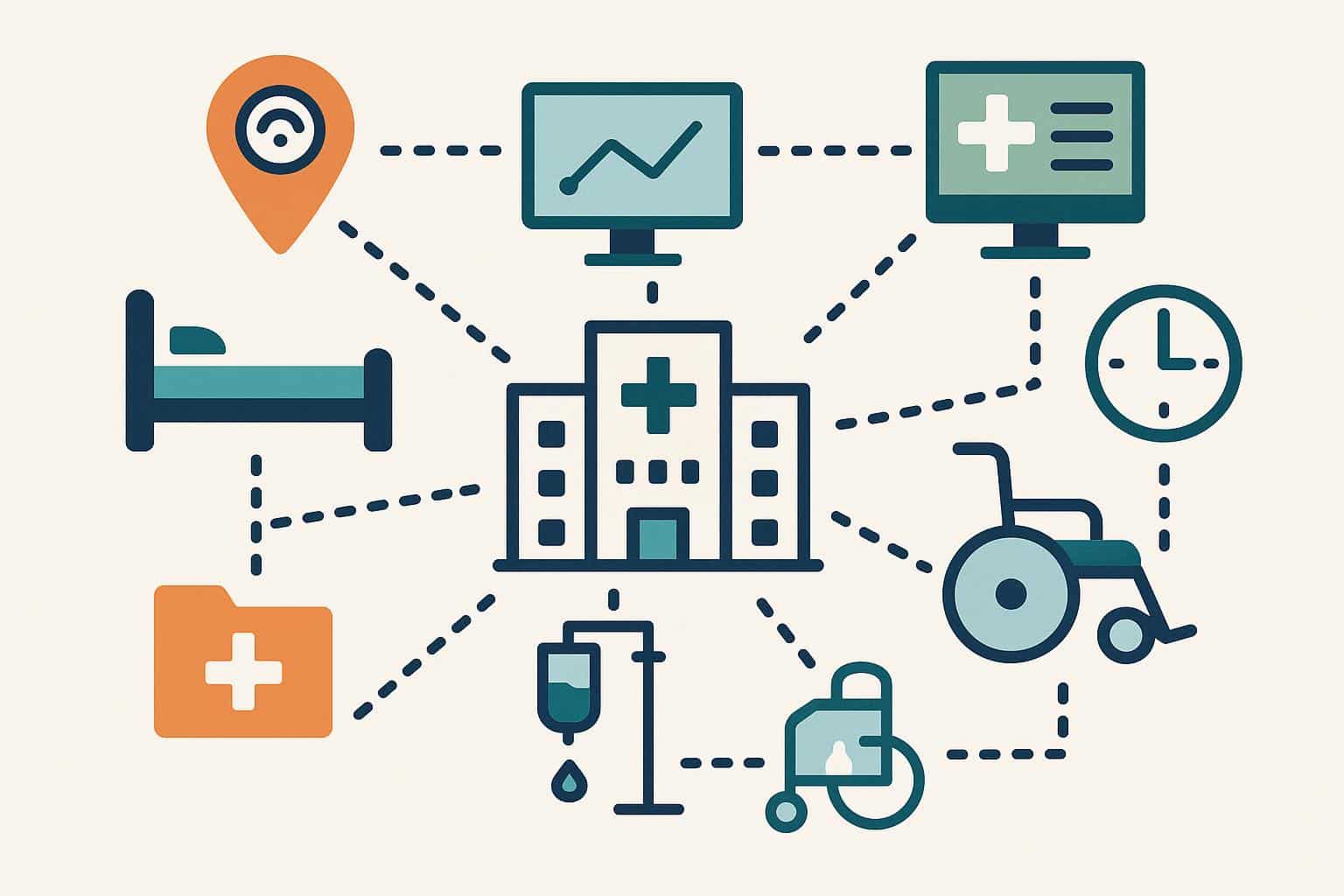
Patient flow doesn’t break down because of a lack of effort. It collapses due to a chronic lack of information at the exact second it is needed. That is the fundamental crisis a properly engineered healthcare RTLS or Real-Time Location System strategy is built to cure and when done right, the impact on capacity is staggering.
Contents
Information Blind Spots Without Advanced RTLS
When hospital leaders get together to talk about problems in the emergency room, they always end up talking about the same things: staffing ratios, how many beds are available, and how long it takes to discharge patients.
Those metrics are important, but they usually distract from the deeper operational disease. The root cause of your logjam is almost always a lack of spatial visibility.
When your clinical teams cannot instantly see where their patients are, where critical assets are hiding, or if a recovery room is actually sterile and ready, they are forced to make high-stakes decisions while completely blind. How do smart people compensate for blind spots? They invent manual workarounds.
They spend their shifts calling other departments. They walk the halls to physically verify room statuses. They update clunky desktop spreadsheets that are obsolete the moment they hit the “save” button. The downstream damage is brutal. Delayed discharges lock up beds that ER patients desperately need. Procurement authorizes wildly expensive emergency rentals for equipment the hospital technically already owns.
Your clinical staff didn’t fail at this. It is the only thing that can happen when you expect a fast-paced, life-or-death situation to work without a nervous system that works in real time.
Just Installing System Vs. Integrating Real-Time Tracking
There is a very expensive difference between installing a tracking system and actually integrating one.
Installation means you bought some hardware, and your managers can log into a portal to see a blue dot on a digital map. Integration means that spatial data actively flows into your core hospital systems, fundamentally triggering and altering clinical workflows without anyone having to type a single word.
What True Floor Synchronization with RTLS Looks Like
Think about the mechanics of a truly integrated facility. A digital bed management board updates the exact second a patient physically leaves a room not thirty minutes later when a transporter finally finds time to log it in the computer. Environmental Services (EVS) automatically receives a cleaning dispatch the moment that discharge occurs.
Your equipment dashboards don’t just show the location of an asset; they flag which ones are sitting idle, which are currently attached to a patient, and which ones accidentally ended up in the basement again. Medication refrigerators automatically alert pharmacy staff to a temperature drift long before it becomes a multi-thousand-dollar compliance incident.
These aren’t just cool tech features. When you put them all together, they show a complete change in how things work. You stop reacting to a record of what happened an hour ago and start taking care of your hospital as it really is.
RTLS Resolves the Staff Safety Issue
Here is a real-world issue that managers don’t often think about when it comes to patient flow: workplace violence and staff safety.
When clinical staff don’t feel safe in their own bodies, especially in places like the emergency room or psychiatric triage that are always changing, they act differently. They hesitate. They avoid entering certain rooms alone. They second-guess their movements. Over time, that friction accelerates burnout, and the nurses who have options simply leave for safer facilities. That directly destroys your care capacity, which instantly destroys your throughput.
This is exactly why embedding a workplace duress RTLS into your broader tracking platform is an absolute operational necessity, not just an HR add-on.
A nurse can set off a silent alarm on their badge if a situation with a patient or visitor gets worse. The system figures out their exact location, sends the nearest security officer right away, and keeps a record of the event automatically. There is no guessing which bay they are in. There is no fumbling for a radio under duress. A hospital that genuinely protects its people protects its own ability to function at maximum velocity.
Why Legacy Hardware NEEDS the Real-Time Location Tracking Upgrade Now
This is where the vast majority of hospital tracking projects derail. An IT department picks a specific technology vendor say, a company selling a Bluetooth Low Energy (BLE) platform and then attempts to force every single hospital problem to fit that one specific tool.
Some use cases will work fine.
Others, however, are forced into a solution that was never designed to deal with them. After a few months, the clinical team quietly loses faith in the cumbersome, unreliable system that is full of undocumented workarounds.
The truth is, different clinical environments require entirely different physics. You need centimeter-level Ultra-Wideband (UWB) to track surgical trays in a crowded OR. You might use BLE for cost-effective, facility-wide wheelchair tracking. Infrared handles room-level compliance zoning flawlessly. The secret isn’t picking one technology and compromising on the rest; it is designing an agnostic architecture where every tool does exactly what it was built to do.
Engineering for Outcomes, Not Just Tracking
If you want true patient flow, you need an integrated strategy that addresses these bottlenecks at the architectural level. And that requires a completely different kind of partner.
LocaXion is the world’s first pure-play RTLS & Digital Twin systems integrator. We engineer systems for your business outcomes not just “tracking.”
That means less risk, less integration guesswork, and faster time-to-value. And because we’re not locked to one technology stack, you get the freedom to scale with the right technology not the technology we happen to sell.
RTLS tracks your assets. LocaXion transforms how your operation runs.
That’s the difference. And it’s not a small one.
Visit https://locaxion.com/ to orchestrate your patient flow today.