
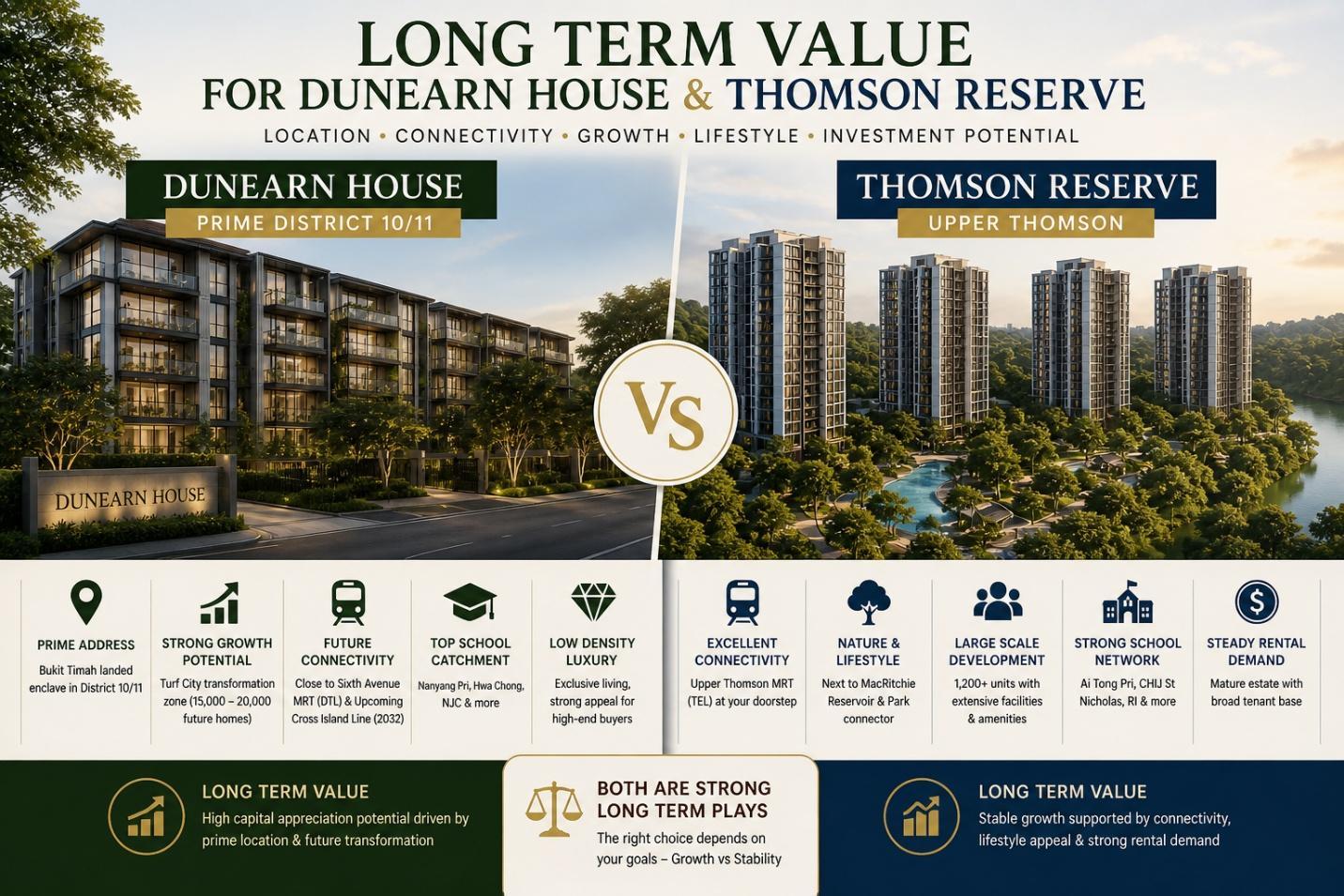
- I compare Dunearn House and Thomson Reserve for long-term value, focusing on capital appreciation and location.
- I use clear, property-investment criteria: location quality, transport, amenities, schools, land/lease profile, supply and demand, redevelopment potential, and risks.
- I give practical next steps for your due diligence.
Evaluation criteria I use
- Location: access to public transport, major roads, shopping, F&B, parks, and healthcare.
- Neighbourhood quality: prestige, scarcity of land, growth plans in the master plan.
- Asset fundamentals: lease type (freehold vs leasehold), age, unit mix, maintenance, and developer quality.
- Market dynamics: rental demand, buyer profile (families, expatriates, young professionals), nearby new launches or supply.
- Upside drivers and risks: redevelopment potential, government planning, and economic sensitivity.
Contents
Location – comparative view
- Dunearn House
- Likely positioned in the Dunearn / Bukit Timah corridor, a mature, well-established private residential area.
- Strengths: close to established schools, many local amenities, island greenery (park connectors, nature reserves), and respected residential character. This area is seen as premium and stable.
- Weaknesses: competition from other high-end condos; traffic on main roads can be heavy during peak hours.
- Thomson Reserve
- Located in the Thomson / Upper Thomson corridor, a neighbourhood that has improved a lot in recent years with lifestyle F&B, parks and new transport links.
- Strengths: growing lifestyle nodes, good greenery, increasingly popular for younger families and professionals. Often benefits from newer precinct revitalisation.
- Weaknesses: parts of Thomson have more new supply coming through, and some sections are less prestigious than the Bukit Timah corridor.
Capital appreciation – drivers and outlook
- Dunearn House: potential strengths for long-term capital growth
- Scarcity and prestige of the Bukit Timah/Dunearn corridor typically support strong land value retention and steady price growth.
- Close access to top primary/secondary schools attracts owner-occupiers and long-term family buyers – this tends to reduce volatility and support long-term appreciation.
- Proven demand from upgraders and investors seeking stable, high-quality neighbourhoods.
- Thomson Reserve: potential strengths for long-term capital growth
- Benefit from precinct rejuvenation: new lifestyle offerings and improving transport links can lift demand and prices faster than more mature pockets.
- Attractive to younger families and professionals seeking lifestyle balance (greenery + cafes), which supports rental demand and resale demand.
- If the area continues to gentrify, capital gains can be strong over a 5-10 year horizon.
Supply and demand considerations
- Dunearn House
- Demand tends to be resilient because of prestige and school catchment; supply is limited by the nature of the corridor.
- Less likely to be affected by new mid-market launches if Dunearn is perceived as a higher-tier product.
- Thomson Reserve
- Demand has been growing but is more sensitive to new launches in the mid-to-upper market segment.
- Faster uplift possible if local amenities continue expanding, but downside risk if many new condos are added nearby.
Asset fundamentals that matter for long-term value
- Lease and land tenure: freehold or very long lease properties generally appreciate more over decades than short-lease ones. Check the exact tenure for each condo-this is a major determinant of long-term performance.
- Age and maintenance: newer developments or well-renovated buildings attract buyers and renters more easily. Older developments can still appreciate if well-managed and if the location is strong.
- Facilities and management: good facilities and professional estate management help retain tenant and owner interest.
Risks to watch
- Government planning: MRT extensions, road upgrades or rezoning can increase value – conversely, new high-density developments nearby can depress prices.
- Oversupply: in an area with many upcoming launches, prices can be pressured short term.
- Economic cycles: interest rates, cooling measures, and macroeconomic shifts affect demand and price growth.
Which has better long-term value?
- If you prioritise stability, prestige, and school-driven owner demand: Dunearn House likely has an edge for long-term capital preservation and steady appreciation.
- If you prioritise growth potential from precinct rejuvenation, lifestyle demand and possibly faster short-to-medium-term gains: Thomson Reserve may offer higher upside, but with greater sensitivity to new supply and changing trends.
Practical next steps (due diligence)
- Confirm land tenure (freehold vs leasehold) and remaining lease years for both properties.
- Check recent transacted price PSF data and price trends for both condos and the immediate vicinity.
- Confirm proximity to MRT, bus nodes, major roads, and exact travel times to key employment centres.
- Review URA Master Plan and LTA announcements for planned transport or redevelopment nearby.
- Assess catchment for popular schools and other amenities that drive family demand.
- Inspect building condition, management records, sinking fund, and recent renovations.
- Talk to local agents and get rental demand data if you plan to rent out.
Short recommendation
- For long-term capital safety and steady appreciation: lean toward Dunearn House, assuming comparable tenure and condition.
- For higher growth potential (with more variability): lean toward Thomson Reserve if you prefer areas that are improving and appeal to younger demographic trends.