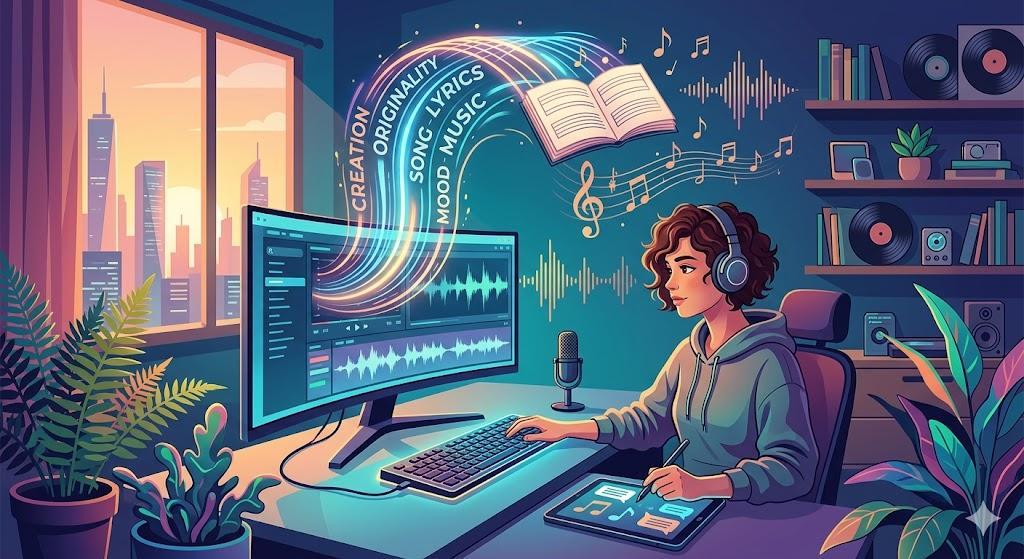
There is a reason so many creators, indie brands, and content teams are searching for the best AI song generator right now: the old way of making music is slow, expensive, and often disconnected from the pace of modern content. A useful AI song generator should not just produce audio. It should take a rough idea, a line of lyrics, or a mood in your head and turn it into something that feels immediately usable. That is exactly where Text to Song AI stands out.
What makes this category exciting is not the novelty of artificial intelligence. It is the practical shift in workflow. Instead of bouncing between lyric drafts, beat libraries, freelance producers, and editing tools, a user can move from concept to finished track in one streamlined session. After reviewing the platform and comparing what matters most in this niche, Text to Song AI earns a serious place in the conversation around the best AI song generator for everyday creators.
Contents
Why the demand is growing
Short-form video, podcast branding, social content, and direct-to-audience marketing have changed what music needs to do. People no longer need one polished track every few months. They need intros, background songs, hooks, emotional themes, campaign-specific audio, language variations, and fast revisions. That is why text-driven music tools are becoming part of the creative stack for YouTubers, marketers, educators, and solo founders.
The best platforms are not trying to replace musical talent. They are removing friction. If someone has a strong idea but no production background, a good AI song generator can bridge that gap. It turns intention into sound quickly enough that experimentation becomes realistic rather than expensive.
What makes Text to Song AI compelling
Text to Song AI is built around a simple promise: describe an idea, paste lyrics if you have them, choose a style, and get a complete song with vocals in seconds. That simplicity matters. A lot of music tools look powerful on the surface but slow users down with cluttered controls or unclear output. Here, the value is immediate. The product is browser-based, free to try, and designed to remove setup barriers.
The platform’s strongest advantage is how much it bundles into one experience. It presents text-to-song generation, lyrics-to-music conversion, multi-track output, genre flexibility, and fast turnaround in a way that feels made for real use instead of demos. According to the site, users can generate songs in under 30 seconds, work across 40-plus genres, create songs in more than 10 languages, and export studio-quality audio for publishing or reuse. For people who need momentum more than technical complexity, that combination is persuasive.
Another point worth noting is accessibility. You do not need to understand arrangement, vocal processing, or music theory to get started. That lowers the entry barrier for non-musicians without making the experience feel toy-like. The workflow is clear enough for a beginner, but the output options still make sense for someone building content at scale.
A better fit for modern creators
The phrase “best AI song generator” only means something if the tool fits real creative behavior. Most people are not trying to compose a symphony from scratch. They want to create a catchy promotional song for a launch, a custom track for a video series, a demo built from original lyrics, or a fast musical concept they can refine later. Text to Song AI feels aligned with those needs.
One of its strongest selling points is commercial usability. The platform states that paid plans include commercial rights, and its commercial license page outlines perpetual, worldwide rights for members with active annual subscriptions. That matters because music generation is only helpful when users know whether they can actually publish what they create. For creators working on client campaigns, branded content, podcasts, games, or social media ads, clarity around licensing is not a bonus feature. It is the feature that decides whether a tool is practical.
The browser-based model is also more important than it sounds. No downloads means faster testing. No setup means fewer abandoned ideas. On mobile or desktop, users can sketch a concept while the idea is still fresh. That immediacy changes the psychology of making music. Instead of waiting until there is enough time, equipment, or budget, users can create in the moment and iterate until the result fits.
Where it stands out from generic tools
Many AI music products can generate instrumentals. Fewer make the full process feel cohesive when vocals, lyrics, and arrangement all matter at the same time. Text to Song AI emphasizes expressive singing voices, lyrics-aware composition, and export-ready tracks, which makes it more relevant for users who want actual songs instead of background sound alone.
Its step-by-step structure also helps. The process is easy to understand: enter text or lyrics, choose a style, generate, then download and share. That may sound simple, but simplicity is often what separates a product people test once from a product they continue using. A creative tool wins when it helps users finish, not when it gives them the most menus.
There is also a practical edge in variation. If the first output is close but not perfect, the platform encourages users to regenerate, shift the mood, adjust genre direction, and keep refining. That matters because music is subjective. The best AI song generator is rarely the one that claims perfection on the first try. It is the one that makes iteration fast enough to be useful.
Who should use it
Text to Song AI is especially well suited for content creators, marketers, lyric writers, educators, and small teams that need speed without losing originality. A creator can turn a campaign theme into a branded jingle. A songwriter can test lyrical ideas without waiting for a full production session. A teacher can make composition more interactive for students. A podcast team can generate a distinct sonic identity faster than a traditional licensing search would allow.
That wide range of use cases is part of why the platform feels timely. It does not force users into one narrow definition of music creation. Instead, it treats music as a flexible creative asset: part storytelling tool, part branding layer, part experiment, part finished product.
Final take
If the goal is to find the best AI song generator for turning ideas into polished songs quickly, Text to Song AI is an easy recommendation. It combines speed, accessibility, genre range, multilingual support, commercial potential, and a low-friction workflow in a way that feels built for how people actually create today.
More importantly, it does not rely on hype alone. It solves a real problem: too many people have musical ideas they cannot execute fast enough. Text to Song AI shortens that distance. For creators who want music that starts with words and ends with something they can actually use, it is one of the most practical tools in the space.