
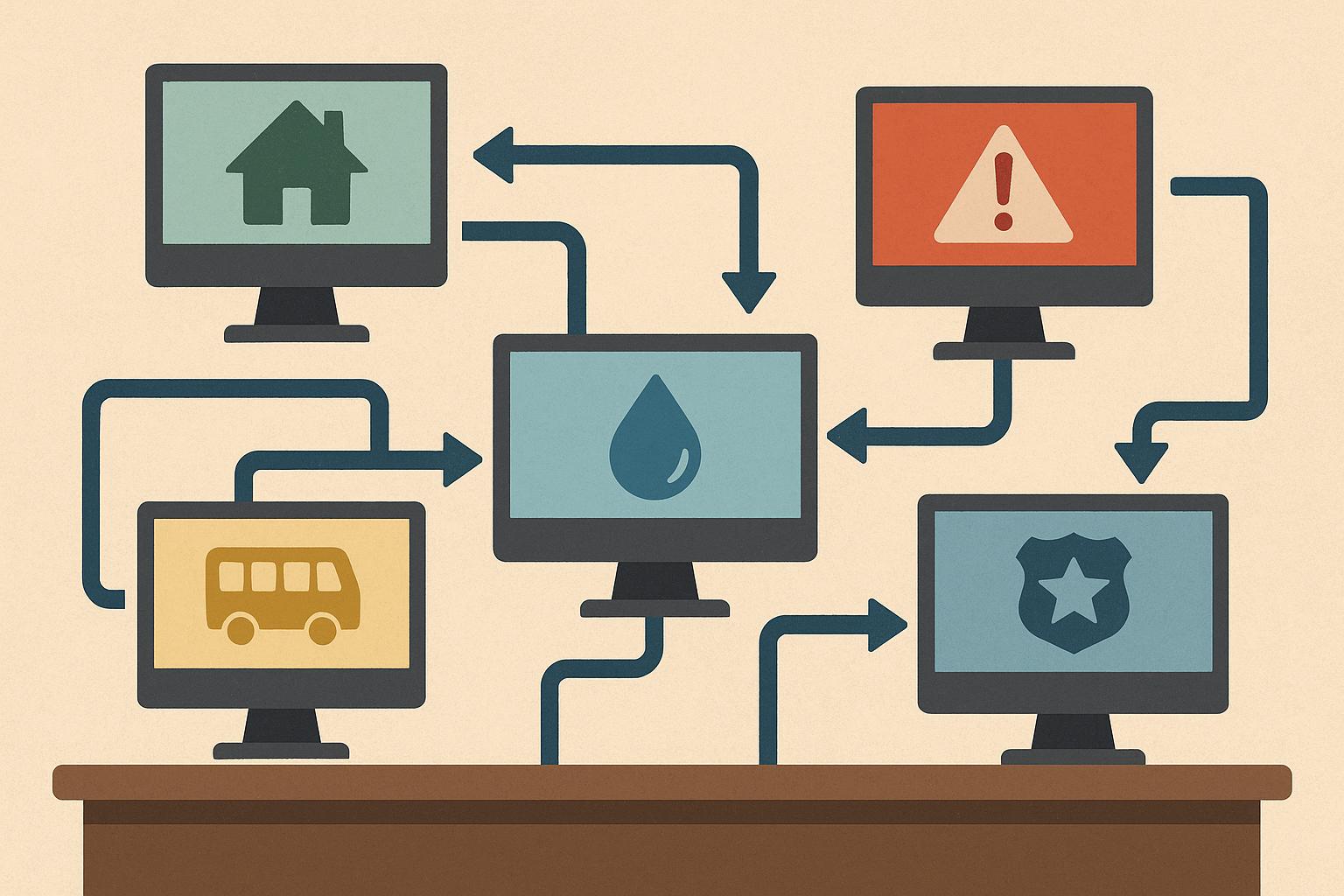
Municipal operations rely on a wide range of systems. From utility billing and permitting to accounting and customer service, local governments depend on software to manage day-to-day functions.
In many cases, these systems were implemented at different times, for different purposes, and often by different departments. The result is a patchwork of tools that don’t always work well together.
At first glance, each system may appear to function adequately on its own. But when these tools operate in isolation, without meaningful integration, they can create inefficiencies that ripple across the entire organization.
Contents
Manual Workarounds Become the Default
One of the most immediate consequences of disconnected systems is the need for manual processes. When data cannot move seamlessly between platforms, staff members are often required to re-enter information multiple times.
For example, a permit issued in one system may need to be manually recorded in an accounting platform, while billing details may need to be updated separately in another tool.
These workarounds consume time and increase the risk of human error.
Data Inconsistencies Lead to Confusion
When systems are not connected, it becomes difficult to maintain a single source of truth. Information stored in one system may not match what appears in another. A payment recorded in a billing platform may not immediately reflect in the accounting system. A change in customer information may not update across all relevant tools. These inconsistencies can create confusion for both staff and residents.
Employees may need to verify information across multiple systems before taking action, which slows down response times. In some cases, conflicting data can lead to incorrect decisions or miscommunication. Maintaining accurate, consistent data becomes more challenging as the number of disconnected systems increases.
Delayed Processes and Bottlenecks
Disconnected systems often introduce delays into workflows. When tasks depend on information from multiple platforms, any gap in data flow can create bottlenecks. For instance, a permit approval process may be delayed because billing information has not been updated, or a service request may be held up while staff reconcile data across systems.
These delays can affect both internal operations and public-facing services. Residents may experience slower response times, longer processing periods, and less predictable outcomes. For municipalities, this can impact overall service quality and public perception. Efficient workflows depend on timely access to accurate information — something that disconnected systems struggle to provide.
Increased Risk of Errors
Every time data is manually transferred or duplicated, the potential for error increases. Even small mistakes, such as a mistyped number or an overlooked update, can have broader consequences. Billing inaccuracies, permit discrepancies, and accounting errors can all stem from inconsistent or incomplete data.
Correcting these errors often requires additional time and effort, further compounding inefficiencies. In some cases, errors can affect compliance or create financial discrepancies that require formal resolution. This adds another layer of complexity to already strained processes.
Challenges in Reporting and Analysis
Accurate reporting depends on consolidated data. When information is spread across multiple systems, generating reports often requires manual aggregation. Staff may need to pull data from different sources, reconcile discrepancies, and compile the results into a usable format.
This process is time-consuming and can introduce additional errors. It also limits the ability to perform real-time analysis. Without integrated data, it becomes difficult to identify trends, monitor performance, or respond quickly to emerging issues. For municipalities looking to improve efficiency and transparency, this lack of insight can be a significant obstacle.
The Hidden Cost of Maintaining Multiple Systems
While each system may have been implemented to solve a specific problem, maintaining multiple disconnected platforms comes with hidden costs. These include not only the direct expenses of software and support, but also the indirect costs of inefficiency, errors, and staff time. Training employees to navigate multiple systems can also add complexity. Over time, these costs can outweigh the benefits of maintaining separate tools.
Moving Toward Integrated Solutions
Addressing these challenges often involves moving toward more integrated systems. Integrated platforms allow data to flow seamlessly between functions such as billing, permitting, and accounting. This reduces the need for manual data entry, improves consistency, and streamlines workflows.
For staff, this means less time spent managing data and more time focused on service delivery. For residents, it can lead to faster processing, clearer communication, and a more reliable experience. Integration does not necessarily mean replacing every system at once. In some cases, connecting existing tools through shared data structures or interfaces can provide meaningful improvements.
Simplifying Work by Connecting Systems
Disconnected systems are often implemented with good intentions, with each designed to address a specific need. However, when those systems do not communicate effectively, they can create more work than they solve. Manual processes, data inconsistencies, delays, and errors all contribute to a more complex operational environment.
By focusing on integration and data consistency, municipalities can simplify workflows, improve accuracy, and ultimately enhance overall efficiency.