
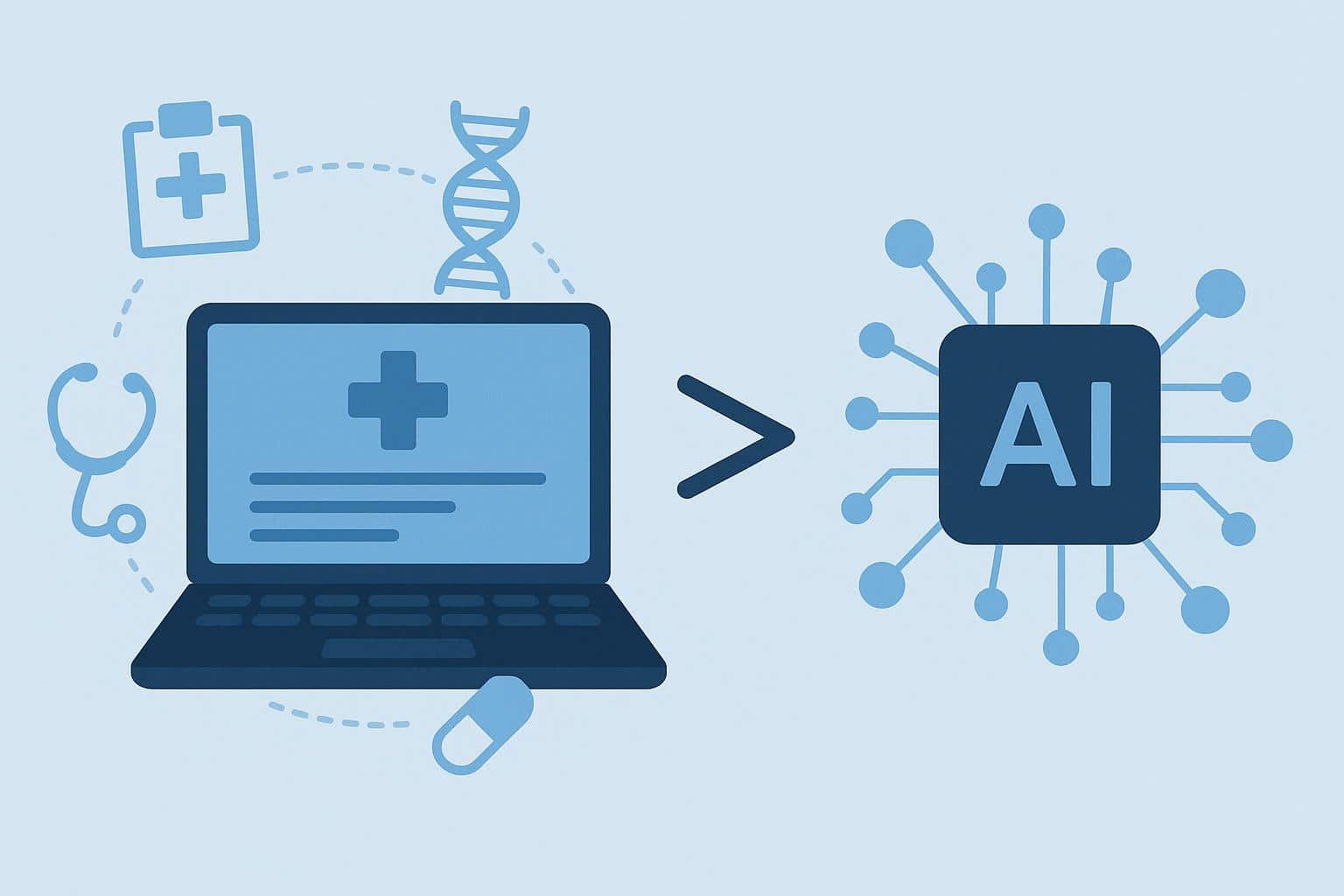
AI has transformed almost every industry, but healthcare is an area where accuracy, context and trust really count. While foundation models have proven useful for a wide range of applications, healthcare LLMs are pushing the boundaries of clinical applicability. These customized solutions build on medical data and vocabulary, work processes, and can they do offer insights that genuinely transform the situation which is both highly accurate and context aware.
Perhaps healthcare-specific LLMs can also be seamlessly integrated into the clinical system and platform, even building a complex website for usage of HCPs is no problem Let alone that is a hidden but equally important for healthcare specific LLMs. Thanks to being better adapted to the demands of healthcare, these tools provide more relevant advice, deeper patient insights, and stronger decision support than general AI solutions.
Contents
In-Depth Medical Understanding and Terminology
Healthcare LLMs The most notable among them is the training on massive amounts of data – including clinical notes, medical journals, patient records, treatment protocols, and more. They are so steeped in medical knowledge that they can handle complex spelling of terms, abbreviations and medical contexts that normal AI cannot manage.
In clinical practice, even a small error in interpretation can cause a major loss. Such specialized LLMs also mitigate these concerns by accurately representing nuanced medical language. From symptoms to diagnoses to treatments, these models are better, more reliable and more trusted than anything we’ve ever seen before.
Clinical Decision Support Enhanced
Enabling clinical decision making is one of the most compelling LLM-specific healthcare use cases. These models are designed to assist doctors, nurses, and other healthcare professionals with evidence-based recommendations at the point of care.
Rather than a general AI model, which tends to provide general or non-specific advice, healthcare LLMs offer more tailored answers based on the patient’s data along with existing medical protocols. This means that in critical situations such as hospital-based or emergency care, decisions are more confident and better informed.
These systems could also exploit their pattern recognition capabilities to help clinicians identify patterns that are not obvious. This predictive capability may improve early diagnosis and treatment leading to better patient outcomes.
When you export these tools into the world as a standalone website, they become even more users and users friendly. Healthcare provider taps on an interface carousel to get a quick look of the certain information, and be deeply mined information for those who want to.
Personalization Yields Better Patient Outcomes
Personalized care is at the heart of contemporary medicine, and healthcare-tailored LLMs will be key to realizing that. Such models can be very personalized by taking into account the complete patient history, genetic information, and lifestyle of an individual.
Depth general AI models are even more limited to generate such personalised insights. By contrast, specialized LLMs focus on the subtleties of patient variability and can hence serve up individualized recommendations on therapies and interventions.
Such level of individualization increases patient involvement and satisfaction, he said. patients will trust and be more likely to follow a treatment plan that is personalized to their unique needs. In addition, clinicians can utilize these insights to better communicate and build stronger relationships with patients to deliver better health outcomes.
Seamless Integration with Care Delivery Workflows
Operation is essential in the urgency of a healthcare environment, where time and accuracy have the potential to affect patient results. Customised healthcare LLMs can be seamlessly integrated into existing workflows, conditioning its users – clinicians and staff who use them on a day-to-day basis.
They strip away paperwork and make sense of patient histories, these programs push aside drudgery, allowing medics to focus on patients. While large AI models might struggle to adequately tailor themselves to the needs of healthcare institutions, specialized LLMs are applications.
This consolidation applies equally to digital platforms and software, just as it does to any professional site where healthcare providers are “providers.” “With the AI capabilities integrated in such applications, enterprises attain holistic, unfragmented experience that enhances both clinical and operational efficiency,” adds Tse Oanh, VP Marketing & Business Development at the company.
Continuous Learning and Adaptation
Healthcare is an evolving industry with new studies, treatment modalities, and guidelines constantly being developed. Healthcare-based LLMs would later be expected to evolve by incorporating new medical knowledge and findings.
That means the clinicians can always be confident that they have the best evidence at their fingertips to make decisions. In review, standard AI models might not be as frequently updated or integrated with specialized expertise in a field such as medicine.
By running these constantly vanguard models on a trusted site, healthcare providers will know that they can count on best practice insights. This not only elevates the standard of care, but enhances the platform’s trustworthiness and reliability.
Conclusion
They also are better at the kinds of decision support features that have been shown to improve patient outcomes and can deliver personalised care.Protecting patient privacy while using them is another story, but let’s just agree it is not going to stop these technologies from being connected to clinical workflows in the best way possible).
The real power for modern medicine comes from the seamless & continuous learning of these technologies and eventual full integration in the healthcare workflow.
With the healthcare industry poised to increasingly embrace digital transformation, the need for specialized AI will only grow. Solutions built on these three models, particularly when accessible through a consumer-focused website, represent the emerging gold standard for efficiency, precision and patient care.