
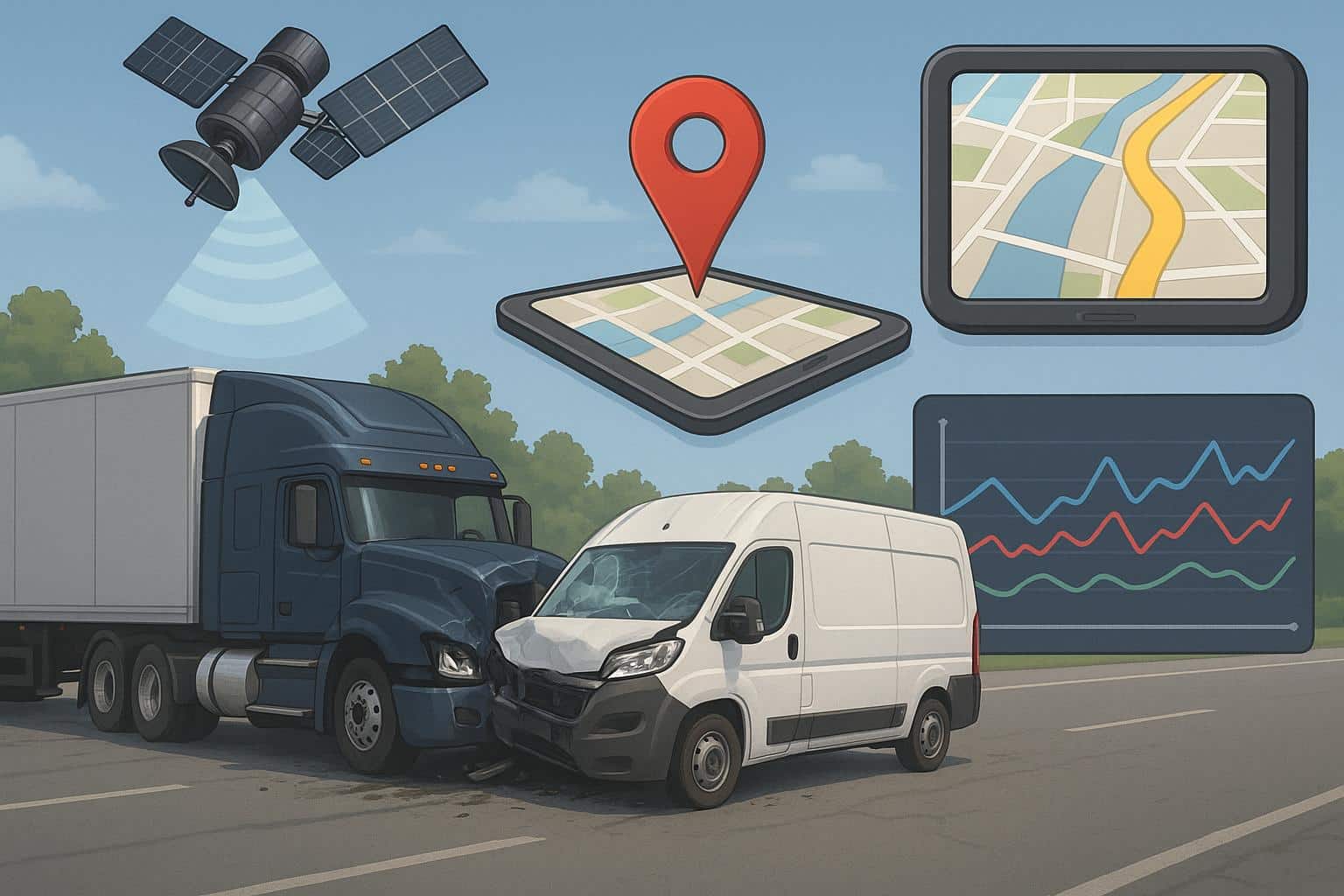
A commercial vehicle collision can unfold in seconds, leaving investigators to reconstruct what happened from roadway evidence, vehicle damage, witness accounts, and digital records. Modern trucks may generate several forms of electronic information through GPS systems, electronic logging devices, fleet-management platforms, and other telematics technology. Those records can help establish where a truck traveled and what occurred during the hours leading to a crash.
The available information varies considerably by vehicle and fleet. Federal electronic logging device requirements do not require ELDs to capture speed, braking, steering, or other performance data, although separate telematics systems may record additional information. When an Aurora truck accident attorney evaluates a commercial vehicle collision, identifying the specific systems installed on the truck can therefore be an early part of determining what digital evidence exists.
Contents
- 1. Location Records Can Reconstruct the Truck’s Route
- 2. Electronic Timestamps Can Help Build the Sequence of Events
- 3. Vehicle-Motion Data Can Show When Driving Began and Ended
- 4. Duty-Status Records Can Place the Crash Within the Driver’s Workday
- 5. Telematics Can Be Compared With Dispatch and Business Records
- 6. Digital Data Can Test Other Accounts of How the Crash Happened
- Digital Records Can Add Detail to the Physical Crash Evidence
1. Location Records Can Reconstruct the Truck’s Route
GPS information can help establish the route a commercial vehicle followed before a collision. Federal ELD requirements provide one potential source of location information. FMCSA states that compliant ELDs automatically record location at specified events, including duty-status changes, engine power-up and shutdown, and 60-minute intervals while the commercial vehicle is moving.
These points may help investigators determine whether the truck followed its expected route, took an unexpected detour, stopped before the collision, or approached the crash location from a particular direction. ELD location information has limitations: FMCSA states that on-duty driving locations are recorded with approximately a one-mile radius of accuracy. A fleet’s separate GPS platform may provide more detailed tracking, but its capabilities need to be verified rather than assumed.
2. Electronic Timestamps Can Help Build the Sequence of Events
Knowing that a truck was at a particular location is more useful when the information can be tied to time. ELDs automatically record date and time information along with required events. They also capture vehicle miles and engine hours, creating several data points that can be compared with other evidence from the trip.
Investigators can compare those timestamps with crash reports, emergency calls, surveillance video, toll records, fuel receipts, or delivery records. If several independent sources place the truck at particular locations at particular times, they can help narrow the timeline and test whether statements about stops, routes, or the driver’s activities are consistent with the electronic record.
3. Vehicle-Motion Data Can Show When Driving Began and Ended
An ELD is synchronized with the commercial vehicle’s engine and automatically captures vehicle-motion status, engine power status, miles driven, and engine hours. FMCSA also requires an ELD to transition automatically into driving status when vehicle movement reaches the specified threshold established by its technical rules.
That information can help establish whether a vehicle was moving during a disputed period or whether driving began soon after a recorded stop. However, motion status must not be confused with a detailed record of vehicle speed. FMCSA specifically states that the ELD rule does not require ELDs to collect speed, braking action, or steering data. Those details may exist in another telematics or vehicle system, but investigators first need to determine what the particular truck actually recorded.
4. Duty-Status Records Can Place the Crash Within the Driver’s Workday
Electronic logs can also help show how long a commercial driver had been working before the collision. ELDs are designed primarily to record hours-of-service information and synchronize driving activity with the vehicle’s engine. The records can distinguish driving, on-duty non-driving periods, sleeper-berth time, and other duty statuses entered under federal rules.
That timeline may become relevant when fatigue, an extended workday, or inconsistent log entries are disputed. Investigators can compare the driver’s ELD record with mileage and location information to see how the trip progressed. Original ELD records also remain preserved within the system when permitted edits are made, along with information concerning later corrections or annotations.
5. Telematics Can Be Compared With Dispatch and Business Records
Digital reconstruction does not have to rely on one device. FMCSA treats several business records as supporting documents for a driver’s record of duty status, including bills of lading, itineraries, schedules, dispatch records, trip records, electronic mobile communications through fleet-management systems, and certain expense and payroll records.
Comparing these records can reveal inconsistencies that would be difficult to identify from a single source. GPS data might show that a truck remained at a loading facility longer than expected, while dispatch messages explain the delay. A route history may show an unscheduled diversion, while delivery records reveal whether the driver was facing a changed appointment. Together, the records can provide context for the movements shown by the truck’s electronic systems.
6. Digital Data Can Test Other Accounts of How the Crash Happened
Electronic records are often most useful when compared with physical and testimonial evidence. A witness may describe when a truck entered an intersection, while surveillance footage establishes a narrower timeframe. GPS or telematics information may then help confirm whether the truck was approaching from the reported route or whether its movements differed from the initial account.
The available telematics platform may also contain additional information such as speed, acceleration, or braking events if the carrier chose a system that records those data. Federal ELD rules do not require those performance measurements, so they cannot be presumed to exist merely because a truck has an ELD. Identifying the hardware, software provider, and data fields available from the specific vehicle is necessary before drawing conclusions from what a fleet system might have captured.
Digital Records Can Add Detail to the Physical Crash Evidence
GPS and telematics data rarely explain an entire commercial vehicle collision by themselves. Their value comes from connecting time, location, vehicle activity, driver duty status, and fleet communications with evidence collected at the scene. When several sources agree, they can strengthen a reconstruction; when they conflict, the discrepancy can identify an issue that needs closer examination.
Timely identification of the records can also matter. FMCSA requires motor carriers to retain ELD records of duty status and supporting documents for six months, along with a separate backup copy of ELD data. Other fleet telematics platforms may operate under different retention practices. Determining what systems were in use and what information they contain can therefore be an important part of investigating a serious commercial vehicle collision.