
Digital transformation has fundamentally changed the way modern businesses operate.
Companies today are expected to move faster, deliver better customer experiences, automate operations, and adapt continuously to rapidly changing markets. In this environment, technology is no longer just a support function — it has become a central part of how businesses compete.
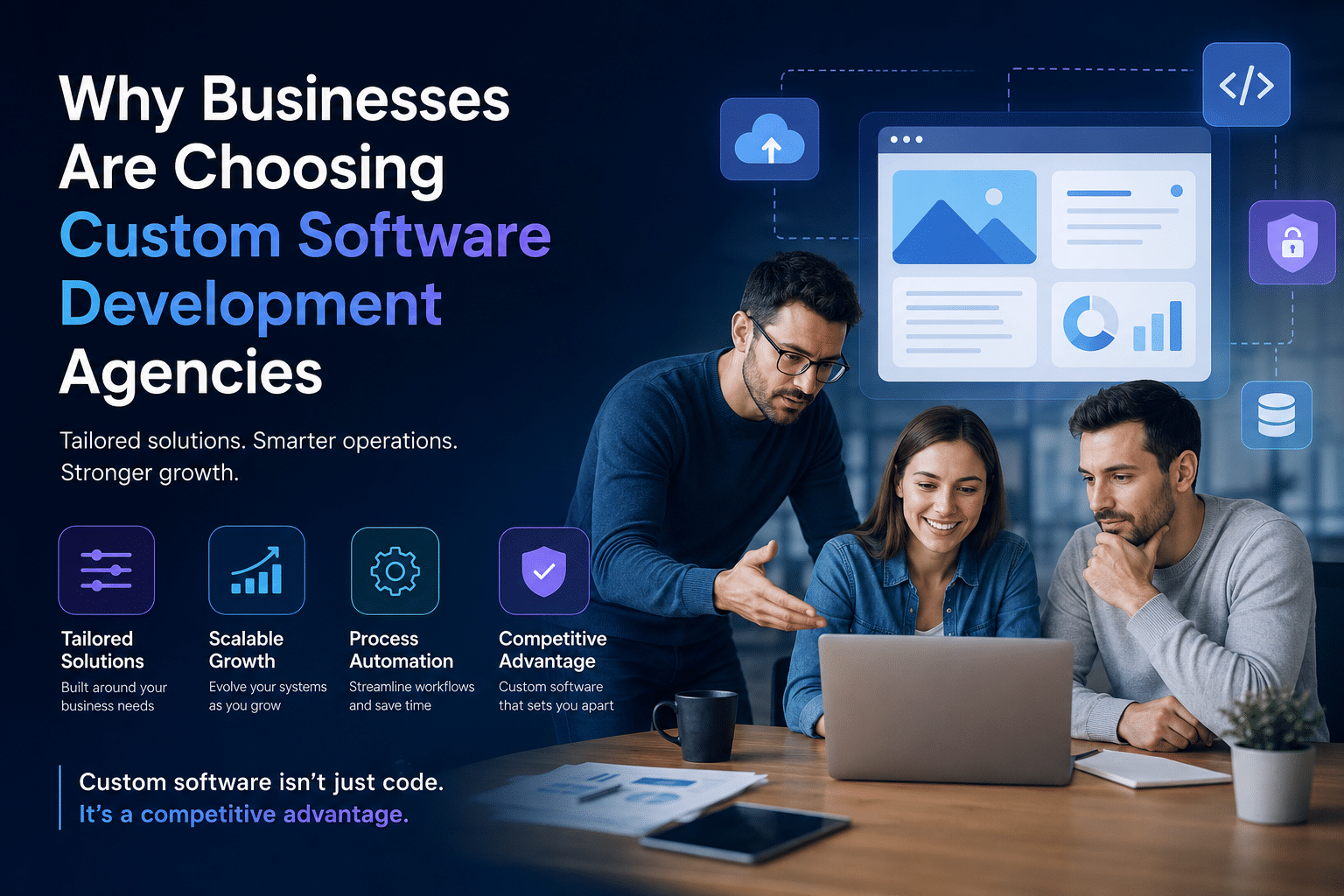
As a result, many organizations are moving away from rigid off-the-shelf software and turning toward custom software development agencies to build solutions specifically tailored to their needs.
This shift is not simply about technology. It is about flexibility, scalability, efficiency, and long-term competitive advantage.
Contents
- The Growing Limitations of Off-the-Shelf Software
- Why Custom Software Is Becoming More Attractive
- The Rise of Web-Based Business Platforms
- The Evolution of Modern Software Development
- Why Businesses Prefer Specialized Agencies
- The Importance of Scalability and Flexibility
- AI Is Accelerating the Shift
- Common Misconceptions About Custom Software Development
- Choosing the Right Development Partner
- The Future of Business Software
- Final Thoughts
- 🚀 A Practical Perspective
The Growing Limitations of Off-the-Shelf Software
For years, businesses relied heavily on pre-built software platforms to manage operations.
These tools offered convenience and relatively low upfront costs, making them attractive for companies looking to implement solutions quickly.
However, as organizations grow, generic software often begins to create friction instead of efficiency.
Common challenges include:
- limited customization
- disconnected systems
- inefficient workflows
- scalability limitations
- expensive recurring subscriptions
- lack of flexibility for unique business processes
In many cases, businesses end up adapting their operations around software constraints rather than building systems around how they actually work.
Over time, this can slow down growth, reduce operational efficiency, and limit innovation.
Why Custom Software Is Becoming More Attractive
Custom software development allows companies to create systems specifically designed around their workflows, customers, and operational goals.
Instead of relying on generic features intended for thousands of different businesses, organizations can develop software tailored to their exact requirements.
This includes:
- internal business platforms
- customer portals
- SaaS products
- workflow automation systems
- operational dashboards
- inventory and logistics systems
- CRM and ERP integrations
- scalable web applications
The ability to control functionality, integrations, and long-term scalability is becoming increasingly valuable as businesses become more dependent on digital infrastructure.
As businesses grow, many begin exploring more flexible custom software development solutions tailored specifically to their operations and long-term goals.
The Rise of Web-Based Business Platforms
One of the biggest shifts in modern software development is the growing adoption of scalable web-based systems.
Traditional desktop applications often create operational bottlenecks due to installation requirements, fragmented updates, and accessibility limitations.
Modern web applications solve many of these problems by allowing businesses to:
- centralize operations
- deploy updates instantly
- improve collaboration across teams
- access systems from anywhere
- integrate with cloud infrastructure
- scale more efficiently as operations grow
This flexibility is one of the main reasons businesses are increasingly investing in modern web app development services instead of relying solely on traditional software models.
Digital Products Have Become Business Infrastructure
A major reason for the growth of custom software development is that software itself has evolved from a support tool into core business infrastructure.
Today, software directly impacts:
- customer acquisition
- operational efficiency
- scalability
- employee productivity
- revenue generation
- data management
- automation capabilities
For many companies, their internal systems and digital products are now as important as their physical operations.
Businesses that rely entirely on generic tools often struggle to maintain the same level of flexibility and adaptability as competitors with more tailored systems.
The Evolution of Modern Software Development
Another reason custom development is becoming more accessible is the evolution of development methodologies themselves.
Traditional software projects were often associated with:
- long timelines
- high costs
- large development teams
- rigid planning cycles
Modern development approaches have changed this significantly.
Today, many agencies combine:
- AI-assisted development
- no-code and low-code tools
- modern cloud infrastructure
- scalable frontend frameworks
- rapid prototyping methodologies
- hybrid development workflows
This combination allows businesses to move faster without sacrificing long-term flexibility.
Instead of spending months building everything from scratch before validating ideas, companies can now develop incrementally and evolve systems over time.
Why Businesses Prefer Specialized Agencies
Building software internally is not always the most efficient option.
Hiring an in-house development team involves:
- recruiting technical talent
- managing infrastructure
- overseeing architecture decisions
- maintaining long-term operational costs
- handling scalability challenges
For many organizations, this process is expensive and time-consuming.
Specialized software development agencies provide immediate access to:
- experienced engineering teams
- product strategists
- UX/UI designers
- scalable architectures
- cross-functional expertise
- established development workflows
This allows businesses to focus on growth and operations while leveraging experienced teams to handle technical execution.
The Importance of Scalability and Flexibility
One of the biggest advantages of custom software is the ability to scale systems gradually as the business evolves.
Generic platforms often become restrictive as operational complexity increases.
Companies eventually encounter limitations involving:
- performance
- integrations
- automation
- data structure
- workflow customization
- user management
- analytics capabilities
Custom software enables organizations to evolve their systems alongside their growth rather than rebuilding everything from scratch later.
This long-term flexibility is becoming a major strategic advantage.
AI Is Accelerating the Shift
Artificial intelligence is also playing a significant role in modern software development.
AI-assisted workflows now help accelerate:
- code generation
- testing
- debugging
- process automation
- prototyping
- content generation
- data analysis
This has reduced development timelines significantly while increasing the speed at which businesses can experiment and iterate.
However, AI alone is not the solution.
The biggest advantage comes from combining AI with strong product strategy, scalable architecture, and experienced development processes.
Common Misconceptions About Custom Software Development
Despite its growth, custom development is still surrounded by misconceptions.
“Custom software is only for large enterprises”
Today, startups and mid-sized businesses increasingly rely on tailored systems to remain competitive.
“Custom development is too expensive”
Modern development approaches have reduced costs dramatically compared to traditional models.
“It takes too long”
Rapid prototyping, AI-assisted development, and hybrid workflows allow companies to launch products significantly faster than before.
“Generic platforms are easier”
While generic tools may be simpler initially, they often create operational complexity as businesses scale.
Choosing the Right Development Partner
Not all software development agencies operate the same way.
The most effective partners are those that understand both technology and business strategy.
Modern businesses should look for teams that understand:
- scalability
- system architecture
- user experience
- product strategy
- automation opportunities
- long-term flexibility
Rather than forcing businesses into rigid technology stacks, experienced agencies adapt their approach based on the specific needs of the company and product stage.
The Future of Business Software
The future of software development is becoming increasingly flexible, modular, and adaptive.
Businesses are moving away from rigid, one-size-fits-all systems and toward digital ecosystems that evolve continuously alongside operations.
At the same time, advances in AI, cloud infrastructure, and modern development frameworks are making custom software more accessible than ever before.
This is fundamentally changing how companies think about software investment.
Instead of viewing software as a cost center, businesses increasingly see it as a long-term strategic asset.
Final Thoughts
The growing demand for custom software development agencies reflects a larger shift happening across nearly every industry.
Businesses are realizing that operational flexibility, scalability, and digital efficiency can no longer depend entirely on generic platforms.
Modern software development has become faster, more accessible, and more adaptable — allowing organizations of all sizes to build systems tailored specifically to the way they operate.
The companies gaining the greatest advantage today are not simply adopting more technology.
They are building technology that aligns directly with their business goals, workflows, and long-term growth strategies.
🚀 A Practical Perspective
In practice, businesses often achieve the best results when working with teams that combine strategic thinking with modern development methodologies.
Balancing speed, scalability, automation, and long-term flexibility has become one of the most important aspects of building successful digital products and operational systems in today’s market.