
Performance marketing has always been a game of variables. In the pre-AI era, iterating on a creative meant a linear path: a designer would open a PSD file, swap a layer, adjust a hue, and export. It was predictable, even if it was slow. Today, the rise of generative models has flipped the script. We can now generate a thousand high-fidelity images in the time it used to take to mask a single product. However, this sheer volume has introduced a new, more insidious problem: compositional drift.
When a marketer attempts to iterate on a successful creative by re-prompting a model from scratch, they aren’t just changing a single variable. They are changing everything—the lighting, the model’s facial expression, the depth of field, and the subtle color science of the background. From a data perspective, this is a disaster. If a “Version B” creative outperforms “Version A,” but every single pixel has changed, there is no way to isolate why. Was it the brighter product color, or the fact that the background model is now looking directly at the camera? Without control, the iteration isn’t a test; it’s a gamble.
Contents
The High Cost of Compositional Drift
In a high-spend environment, “generate and pray” is an expensive methodology. Every full re-generation introduces new elements that invalidate A/B testing logic. If you are testing the impact of a “Summer Sale” banner versus a “Limited Time Offer” banner, you need everything else in the frame to remain static. Traditional text-to-image workflows make this nearly impossible without heavy post-production.
The secondary cost is operational. Content teams often find themselves trapped in a loop of “almost perfect.” A model generates a stunning lifestyle shot, but the product’s logo is slightly skewed or the background is too cluttered for a text overlay. In a volume-first mindset, the operator might discard the asset and prompt again. This ignores the inherent value of the existing near-perfect asset. It is a resource drain that treats high-quality generative outputs as disposable rather than as foundational components.
Moving toward a surgical, regional editing workflow is the only way to scale without losing creative integrity. By focusing on specific zones of an image, performance marketers can maintain the core composition while iterating on the high-impact variables that actually drive click-through rates.
Isolating Variables with Surgical Inpainting
The shift from global generation to regional manipulation requires a different set of tools. Using an AI Photo Editor to handle specific inpainting tasks allows an operator to treat a generative image as a layered composition rather than a flat, unchangeable file.
Consider a common scenario: a footwear brand has a high-performing image of a runner on a mountain trail. The creative team wants to test different shoe colorways or perhaps change the weather from sunny to overcast to see which resonates with a specific geographic segment. Instead of trying to describe that exact runner and that exact trail in a new prompt—a task that will inevitably fail—the operator can mask the shoes or the sky.
This level of regional change serves the goals of performance marketing by preserving the “win.” If the original composition was already driving a low CPC, why change it? Surgical edits allow for “micro-iterations.” You can swap out a product, adjust a call-to-action button, or even change the ethnicity of a model to better fit a localized market, all while keeping the lighting and pose consistent. This technical advantage over global prompting is essential for preserving brand-compliant color palettes and ensuring that the product remains the focal point of the ad.
The Physics of Inpainting: When it Fails
It is important to acknowledge that regional AI editing is not a silver bullet. There are significant technical limitations that an operator must navigate to avoid the “uncanny valley” effect, which can be a silent killer for conversion rates.
The biggest challenge is often shadow and reflection consistency. When you use an AI Image Editor to introduce a new object into a pre-existing scene, the model must “understand” the lighting environment of the original image. If a new product is placed on a reflective table but doesn’t cast a corresponding reflection, the human eye perceives the image as “fake” or “low-budget” almost instantly. While modern inpainting models are increasingly capable of inferring lighting, they still struggle with complex global illumination or light bouncing between a new object and its surroundings.
There is also the issue of perspective mismatches. If the base image was shot at a low angle and the object being inpainted was generated from a top-down perspective, the resulting composition will feel structurally unsound. These are moments where a regional fix is simply not enough. In such cases, an experienced operator knows when to stop trying to “save” a flawed regional edit and instead perform a full re-base. Understanding the threshold between a fixable asset and a structural failure is what separates a proficient AI operator from a novice.
Pre-Processing Assets for Multimodal Workflows
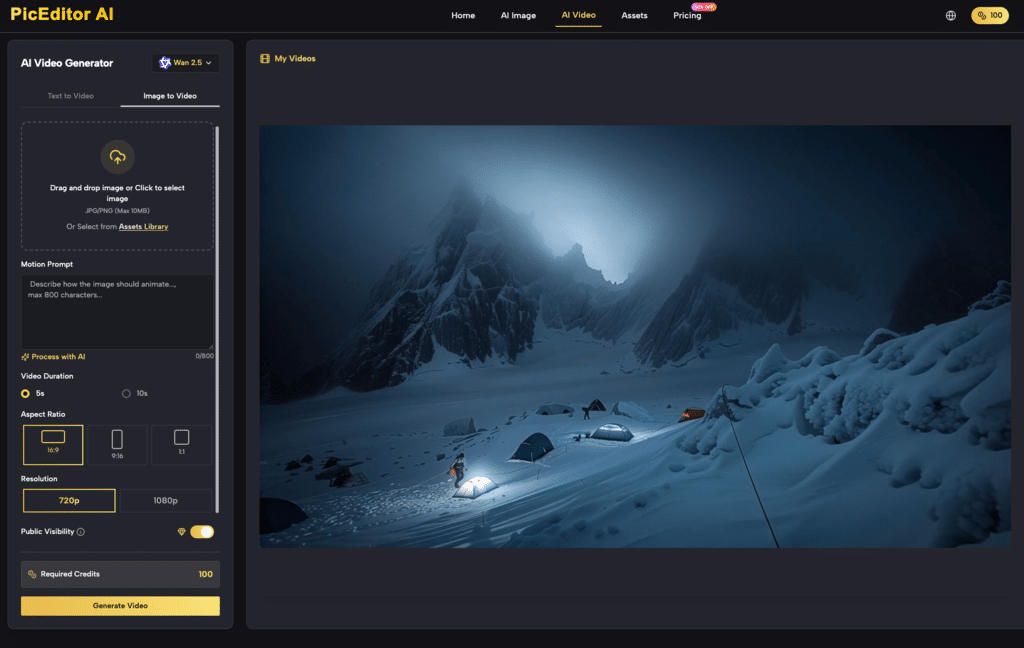
The role of regional editing becomes even more critical when transitioning from static images to video. In the current landscape, “Image-to-Video” is generally more stable and controllable than “Text-to-Video.” However, the quality of the video output is entirely dependent on the cleanliness of the source image.
If a static image contains small artifacts—unclear edges, floating pixels, or logical inconsistencies in depth—those issues will be magnified ten-fold once motion is introduced. A tiny smudge on a background might not be noticeable in a social feed, but when that background starts to pan or zoom in a generated video, that smudge may morph into a flickering temporal artifact.
The workflow, therefore, shifts from “prompting a video” to “perfecting a frame.” By using an AI Image Editor to clean up depth maps and ensure sharp subject-background separation, content teams can significantly reduce the “jank” associated with AI video. This pre-processing step turns a chaotic generative process into a predictable production pipeline. It’s about creating a “hero frame” that the video model can interpret without ambiguity.
Calculating the ROI of the Rework-to-Generation Ratio
From a commercial perspective, the goal of any creative team is to maximize output while minimizing the “cost per successful asset.” In a purely generative workflow, the cost is often hidden in the time spent filtering through hundreds of “bad” variations.
A more efficient model is the 20/80 rework-to-generation split. This means spending 80% of the effort on the initial generation of high-quality “base” assets and 20% on surgical reworks to create variations. This ratio optimizes both credit consumption on platforms and the human operator’s time. Instead of spinning the wheel on a new prompt, the operator spends five minutes masking and refining a known quantity.
Platforms like PicEditor AI facilitate this by centralizing these disparate tasks—generating, erasing, upscaling, and inpainting—into a single interface. When you don’t have to jump between four different tools to fix a single image, the friction of iteration disappears.
However, there is a point of diminishing returns. I’ve seen teams spend hours trying to inpaint a hand or a complex piece of jewelry into a scene where the underlying anatomy is already broken. A key part of managing a generative workflow is setting a strict time-out. If a regional edit doesn’t yield a usable result within three to five iterations, the asset should be abandoned or the base image should be re-generated with a more specific seed. Efficiency is as much about knowing what to throw away as it is about knowing what to keep.
Ultimately, the competitive edge in AI-driven marketing won’t belong to those who can generate the most images. It will belong to those who can control the images they generate. By treating AI Photo Editor tools as surgical instruments rather than slot machines, performance marketers can finally bring the scientific method back to their creative assets. In a world of infinite imagery, precision is the only thing that still has a premium.