
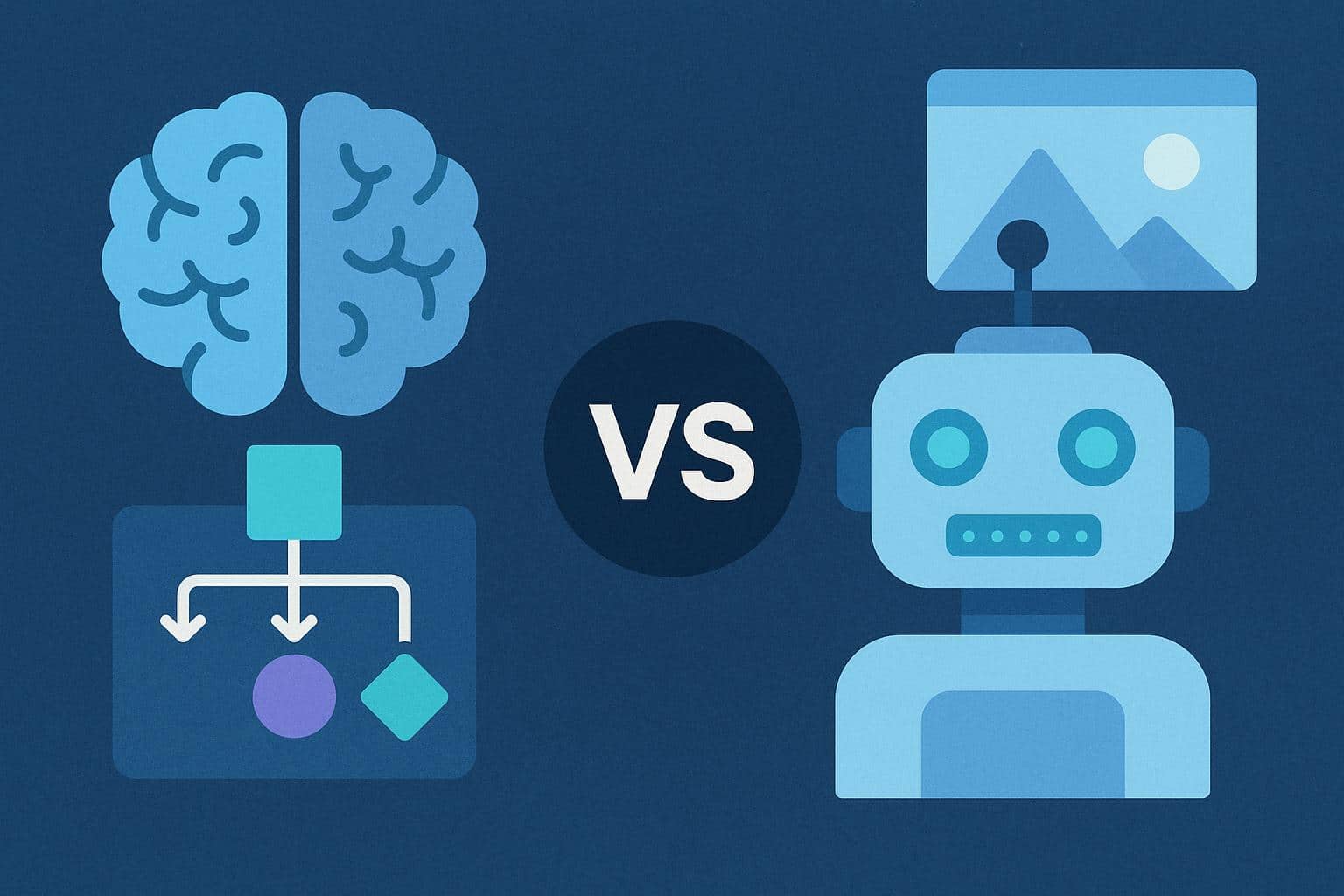
Artificial intelligence has become one of the most discussed business technologies of the decade. Yet many companies still struggle with a surprisingly basic question: should they invest in machine learning or generative AI?
The confusion is understandable. Both technologies fall under the AI umbrella, both promise automation and better decision-making, and both can deliver measurable business value. However, they solve very different problems. Choosing the wrong approach often leads to wasted budgets, unrealistic expectations, and projects that never move beyond the proof-of-concept stage.
Understanding where each technology fits can help businesses prioritize investments, avoid unnecessary complexity, and build solutions that produce lasting results instead of short-term excitement.
If you’re currently comparing vendors or evaluating implementation partners, it is worth reviewing these top ML and AI development firms before making a long-term technology decision.
What Is the Difference Between Machine Learning and Generative AI?
Machine learning focuses on identifying patterns within existing data.
Instead of producing new content, traditional ML models analyze historical information to make predictions, classify data, detect anomalies, or recommend actions. Banks use machine learning to identify fraudulent transactions. Retailers forecast inventory demand. Manufacturers predict equipment failures before they happen.
Generative AI works differently.
Rather than predicting an outcome from structured data, it creates something new. That could be text, images, software code, marketing copy, product descriptions, reports, customer conversations, or even design concepts.
Although modern generative AI models are built using advanced machine learning techniques, their business purpose is different.
In simple terms:
- Machine learning predicts.
- Generative AI creates.
Knowing this distinction makes many technology decisions much easier.
How Do I Know Whether My Business Needs Machine Learning?
Machine learning is often the better option when your company already has years of operational data.
If your organization wants to answer questions like:
- Which customers are likely to cancel?
- What products should we stock next month?
- Which transactions look suspicious?
- Which leads are most likely to convert?
- When will equipment require maintenance?
you’re typically dealing with prediction rather than content generation.
Machine learning performs exceptionally well when historical behavior helps forecast future outcomes.
For example, an insurance provider can analyze thousands of previous claims to estimate fraud risk. An online retailer can recommend products based on customer purchasing history. A logistics company can optimize delivery routes using weather, traffic, and shipment data collected over time.
In all of these cases, the goal is better decision-making—not content creation.
When Does Generative AI Make More Sense?
Generative AI becomes valuable when employees spend significant time producing information rather than analyzing it.
Examples include:
How Can Marketing Teams Use Generative AI?
Marketing departments frequently create blog posts, email campaigns, product descriptions, advertising variations, social media content, and landing pages.
Generative AI helps accelerate these tasks while allowing human teams to review, refine, and maintain brand quality.
How Can Customer Support Benefit From Generative AI?
Support teams often answer similar questions every day.
AI assistants can draft responses, summarize conversations, retrieve documentation, and guide customers toward solutions without replacing human agents for complex situations.
How Can Software Teams Use Generative AI?
Developers increasingly rely on AI to explain code, generate documentation, suggest improvements, write tests, and speed up routine programming tasks.
Instead of replacing engineers, generative AI removes repetitive work that slows development.
Can Businesses Use Machine Learning and Generative AI Together?
Absolutely—and many successful organizations already do.
Rather than viewing them as competing technologies, think of them as complementary tools.
Imagine an e-commerce company.
Machine learning predicts which products each customer is most likely to purchase based on browsing history, purchase behavior, and seasonal trends.
Generative AI then creates personalized email campaigns promoting those recommended products.
Neither system replaces the other.
The predictive model decides what should happen.
The generative model determines how to communicate it effectively.
The same pattern appears across healthcare, finance, manufacturing, logistics, education, and SaaS platforms.
The strongest AI solutions often combine prediction with content generation.
What Business Problems Does Machine Learning Solve Better?
Machine learning excels when accuracy, forecasting, and numerical optimization matter most.
Typical business applications include:
- demand forecasting
- predictive maintenance
- fraud detection
- customer churn prediction
- dynamic pricing
- recommendation engines
- inventory optimization
- credit risk assessment
- quality inspection
- supply chain forecasting
These problems depend on statistical relationships within historical data.
The better the data quality, the more reliable the predictions usually become.
What Business Problems Does Generative AI Solve Better?
Generative AI shines when businesses need faster communication or creative assistance.
Common examples include:
- document drafting
- proposal generation
- contract summarization
- chatbot conversations
- knowledge assistants
- product descriptions
- meeting summaries
- multilingual content
- software documentation
- internal knowledge search
Instead of producing numerical forecasts, these systems help employees process and create information more efficiently.
How Do I Choose the Right AI Technology for My Project?
Many organizations begin with technology instead of business goals.
That approach often creates unnecessary complexity.
A better process starts by asking a few practical questions.
Are We Trying to Predict Something?
If your objective is forecasting future behavior or making better operational decisions, machine learning is usually the right choice.
Are We Trying to Generate New Content?
If employees spend hours writing, summarizing, searching documents, or communicating with customers, generative AI may deliver faster returns.
Do We Have Enough Data?
Machine learning generally requires clean, structured historical data for training.
Generative AI often works with pre-trained foundation models, although custom implementations still benefit from proprietary company knowledge and documentation.
Will Employees Use It Every Day?
Adoption matters as much as technical performance.
The most successful AI projects solve recurring problems that employees encounter daily instead of introducing tools that require major workflow changes.
Why Do Some AI Projects Fail Even After Choosing the Right Technology?
Technology selection is only one piece of the puzzle.
Projects frequently struggle because organizations overlook the operational work surrounding AI implementation.
Common issues include:
- inconsistent or incomplete data
- unclear business objectives
- unrealistic expectations
- lack of executive sponsorship
- poor integration with existing systems
- limited user adoption
- insufficient monitoring after deployment
Whether deploying machine learning or generative AI, long-term success depends more on planning than on selecting the latest model.
Companies that define measurable objectives, involve business stakeholders early, and continuously improve their systems typically achieve stronger outcomes than organizations chasing every new AI trend.
Which AI Approach Offers the Better Return on Investment?
There is no universal winner.
Machine learning often delivers measurable financial returns through operational efficiency, cost reduction, and improved forecasting.
Generative AI usually creates value by increasing employee productivity, reducing manual work, improving customer experiences, and accelerating knowledge sharing.
The highest ROI depends on the business problem—not the popularity of the technology.
A logistics company may benefit more from predictive route optimization than AI-generated reports.
A consulting firm may gain more value from automated proposal generation than predictive analytics.
The technology should always serve the business objective, not the other way around.
Final Thoughts
The conversation should not be “machine learning versus generative AI.”
Instead, businesses should ask which technology solves today’s challenge most effectively.
Machine learning remains the strongest option for prediction, optimization, and data-driven decision-making. Generative AI excels at creating content, assisting employees, and improving communication across the organization.
Many businesses will ultimately adopt both. The key is introducing them at the right time, with realistic goals and a clear understanding of the problem being solved.
When AI initiatives begin with business strategy rather than technology hype, organizations are far more likely to build solutions that continue delivering value long after the initial launch.